
The sound of spruce, the beauty of maple
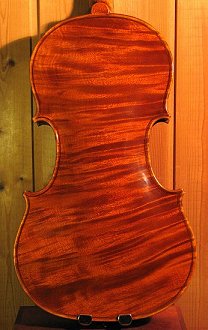
The type of wood used by violin makers today to build the violin is the same as that used 400 years ago. Indeed,
the centuries-old experience of the old Masters defined the woods to be used: maple for the lower part and spruce for the upper part.
Maple is famous all over the world for its leaf, the symbol of Canada. Its figure, sometimes very pronounced,
is in part what makes the instrument beautiful.
Maple, of the Aceraceae family, has 120 species and grows in the northern hemisphere. Its fruit (samara) looks like an aeroplane propeller blade.
Six species grow in Italy. The most common are Acer campestre, known as field maple (in Italian acero comune or oppio), used for hedges; Acer pseudoplatanus, known as sycamore maple
(in Italian acero di monte), up to 30 m tall, used to line avenues; Acer platanoides, known as Norway maple;
and Acer monspessulanum, known as Montpellier maple, which is used to support vines.
Maple wood is good to work and can be smoothed perfectly in violin making, cabinet making and inlay work.
Acer pseudoplatanus is the largest European maple and can reach considerable size. It lives alongside beech up to an altitude of about 1,500 - 1,600 metres.
The bark of young trees is grey, while it takes on pinkish shades as the tree ages.
The best maple for violins comes from the Balkans. There are also frequent exceptions to the use of maple. In old instruments, beech, poplar, willow, walnut, cherry, pear and lime
were sometimes used instead of maple. In the past these woods were used for various reasons: good maple was not always to be found, or perhaps it was too expensive for the customer.
Today, it is a deliberate choice.
Red spruce is an evergreen conifer that grows slowly and reaches maturity after more than 150 years.
It is found on particular ground with an ideal northern exposure and grows at altitudes from 1,000 to 2,300 m, all characteristics that make it possible to
obtain a very stable and well-structured wood, able to transmit sound waves in the best possible way. For this reason it is called "resonance wood".
Spruce is the wood most used for building the soundboard. Red spruce wood is in fact particularly elastic,
it transmits sound better and its resin canals are like tiny organ pipes that create resonance.
The trees are felled during the waning moon, between October and November, when there is less sap
in the trunk. 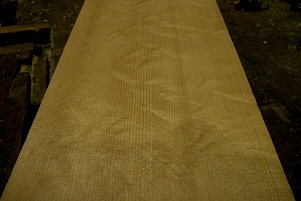
But the quality of the wood is not everything: it has to be cut correctly. There are two main cuts:
radial and tangential. Only with the radial cut can we make the best use of the qualities of
our spruce plank. For the maple back, the tangential cut can also be used.
The wood is seasoned in a dry, ventilated place and this takes a long time, with a minimum
of ten years. The older the wood, the better it will sound.
Another much-used wood is ebony, for making the fingerboard, the pegs, the tailpiece and the chinrest.
Ebony, the common name of Diospyros ebenum, is a tree native to India, Java and Madagascar;
it yields a wood of a characteristic deep black colour, lit by dark red reflections,
with no cross-grain, very heavy (relative dry density about 1), extremely hard, compact and very fine-grained.
It does not crack and is not attacked by insects.