
From antiquity to the Renaissance
The violin was perfected in Cremona more than four hundred years ago by the hands of skilled craftsmen, following
centuries of empirical research, slowly taking the shape we know today.
It is in December 1523 that we find, in the treasury register of Savoy, the word violin written for the
first time.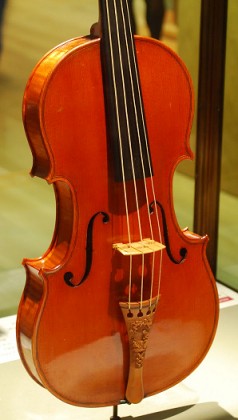
Thanks to the ingenuity of skilled craftsmen of the Middle Ages and then of the Renaissance, a perfect balance was reached between
the shape of the instrument and its sound.
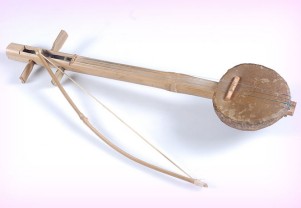
The European violin derives from various bowed string instruments, originating in India and later in the Middle East.
Makers of bowed instruments probably drew on several types of instrument: the rebec, derived from the Arabic rebab,
the viola da braccio, the gigue and the lira da braccio. One of the first precise descriptions of the instrument is contained in the Epitome
musical by Philibert Jambe de Fer, published in Lyon in 1556. By this date, the violin had already begun to spread
across Europe.
The violin appears in Italy in the first half of the 16th century, probably before 1530. It was first
born as the baroque violin, then turned into the modern violin from the end of the 18th century on, at the request of musicians who wanted
a more powerful instrument that was more comfortable to play. The neck and the bass bar were modified.
It was the Italians who brought the violin to the peak of its development, with Andrea Amati (1505-1577) and Antonio Stradivari
(1644-1737). It is difficult, however, to attribute the invention of the violin with certainty: it may instead belong
to Gasparo Bertolotti of Brescia, known as Gasparo da Salò.
Until the middle of the 18th century, the violin was played in a free position. Its place under the chin was not
yet a fixed rule. With the arrival of the chinrest (the first was made in 1830), the violin came to be held more and
more between the shoulder and the chin, also thanks to the shoulder rest, thus allowing the left
hand, freed from the task of supporting the instrument, to slide along the fingerboard.
The violin is today the virtuoso instrument par excellence and represents the voice of what is generally called "classical" music.